Ciò che resta
quando il tempo si ferma.What remains
when time stands still.
Giappone — Dove il rosso trattiene la notteJapan — Where Red Holds the Night
In questo Giappone immaginato, le lanterne restano accese anche quando nessuno sembra dover tornare. Il marmo abita i templi, l’acqua prolunga il rosso, la nebbia interrompe le distanze. Ogni scena conserva qualcosa di incompiuto: un saluto, un attraversamento, una veglia. Una piccola figura scura compare ai margini, con due occhi bianchi. Attraverso dieci luoghi, la notte prende la forma di un ricordo che non sappiamo ancora a chi appartenga.In this imagined Japan, lanterns stay lit even when no one seems expected home. Marble inhabits the temples, water carries the red light, and fog interrupts the distances. Each scene holds something unfinished: a farewell, a crossing, a vigil. A small dark figure appears at the edges, with two white eyes. Across ten places, night takes the shape of a memory whose owner we have yet to discover.
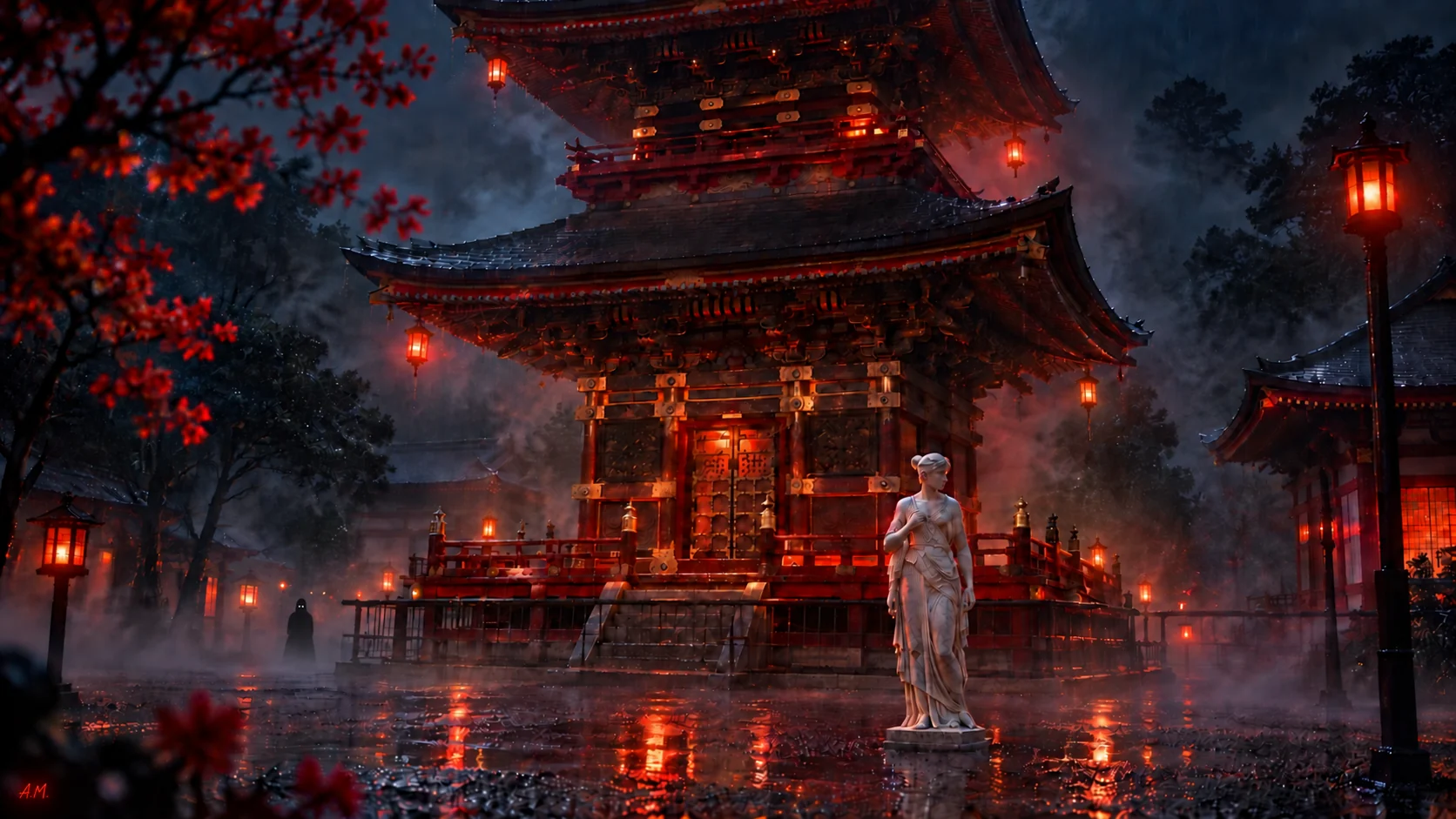
Davanti alla pagoda, la figura bianca ha trovato un luogo in cui aspettare. La luce rossa arriva fino a lei, come se qualcuno avesse lasciato acceso per il suo ritorno. Eppure è già qui. Fra il marmo e la soglia rimane una distanza che nessun passo sembra poter colmare.Before the pagoda, the white figure has found a place to wait. Red light reaches it, as though someone had left a lamp burning for its return. Yet it is already here. Between the marble and the threshold, a distance remains that no step seems able to bridge.
La veglia delle cose immobiliThe Vigil of Still Things
EF–JP–01 Adriano Muzzi · 2026
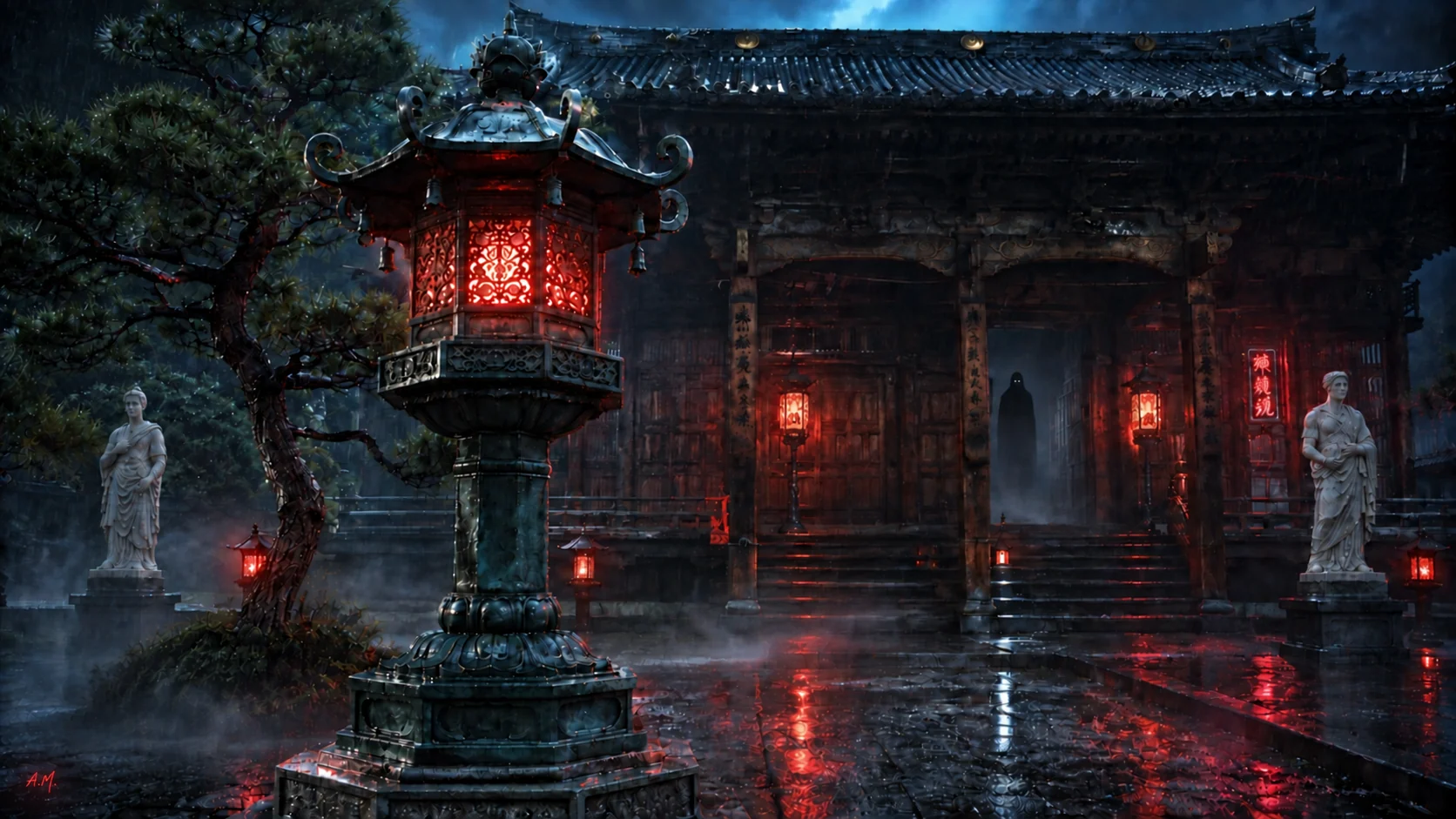
La lanterna è rimasta accesa per qualcuno che conosceva la strada. Sul selciato bagnato, il rosso arriva più lontano della voce. Le figure di marmo vegliano davanti al tempio, senza chiedere quanto manchi al ritorno. Forse la notte dura soltanto perché nessuno ha ancora trovato il coraggio di spegnere quella luce.The lantern has been left burning for someone who knew the way. Across the wet paving, red light travels farther than a voice. The marble figures keep vigil before the temple, never asking how long until the return. Perhaps night endures only because no one has yet found the courage to put out that light.
Le campane dell’ora assenteThe Bells of the Missing Hour
EF–JP–02 Adriano Muzzi · 2026
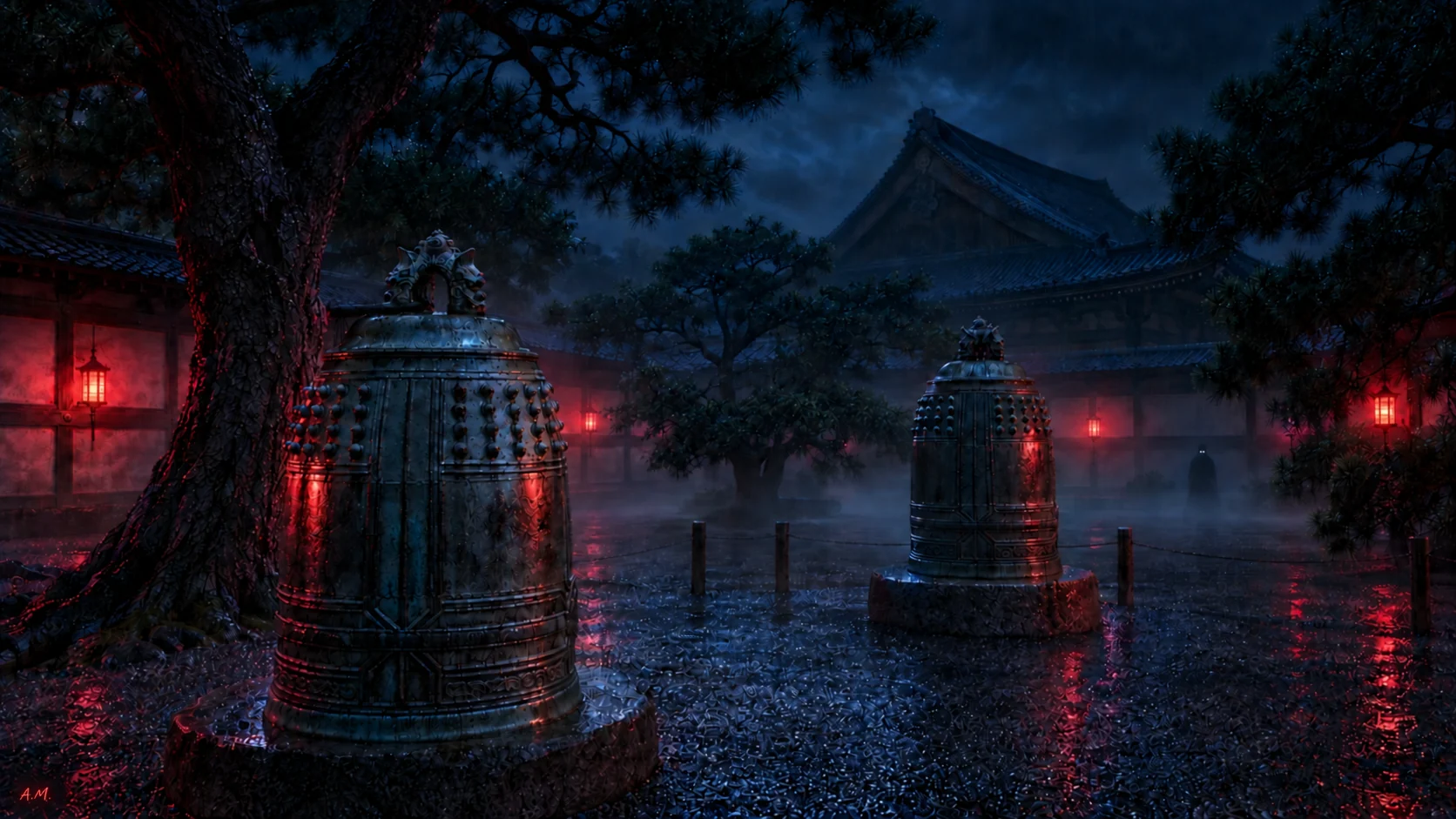
Fra le due campane è rimasta un’ora che nessun calendario riconosce. Il bronzo ne custodisce il peso, mentre una luce rossa sfiora le superfici umide. Basterebbe un solo rintocco per rimettere in moto il cortile. Ma chi ascolta da lontano teme che quel suono possa chiamarlo per nome.Between the two bells, an hour remains that no calendar recognises. The bronze holds its weight as red light brushes the damp surfaces. A single toll would be enough to set the courtyard in motion again. Yet whoever listens from afar fears that the sound might call them by name.
La bottega delle notti perduteThe Shop of Lost Nights
EF–JP–04 Adriano Muzzi · 2026
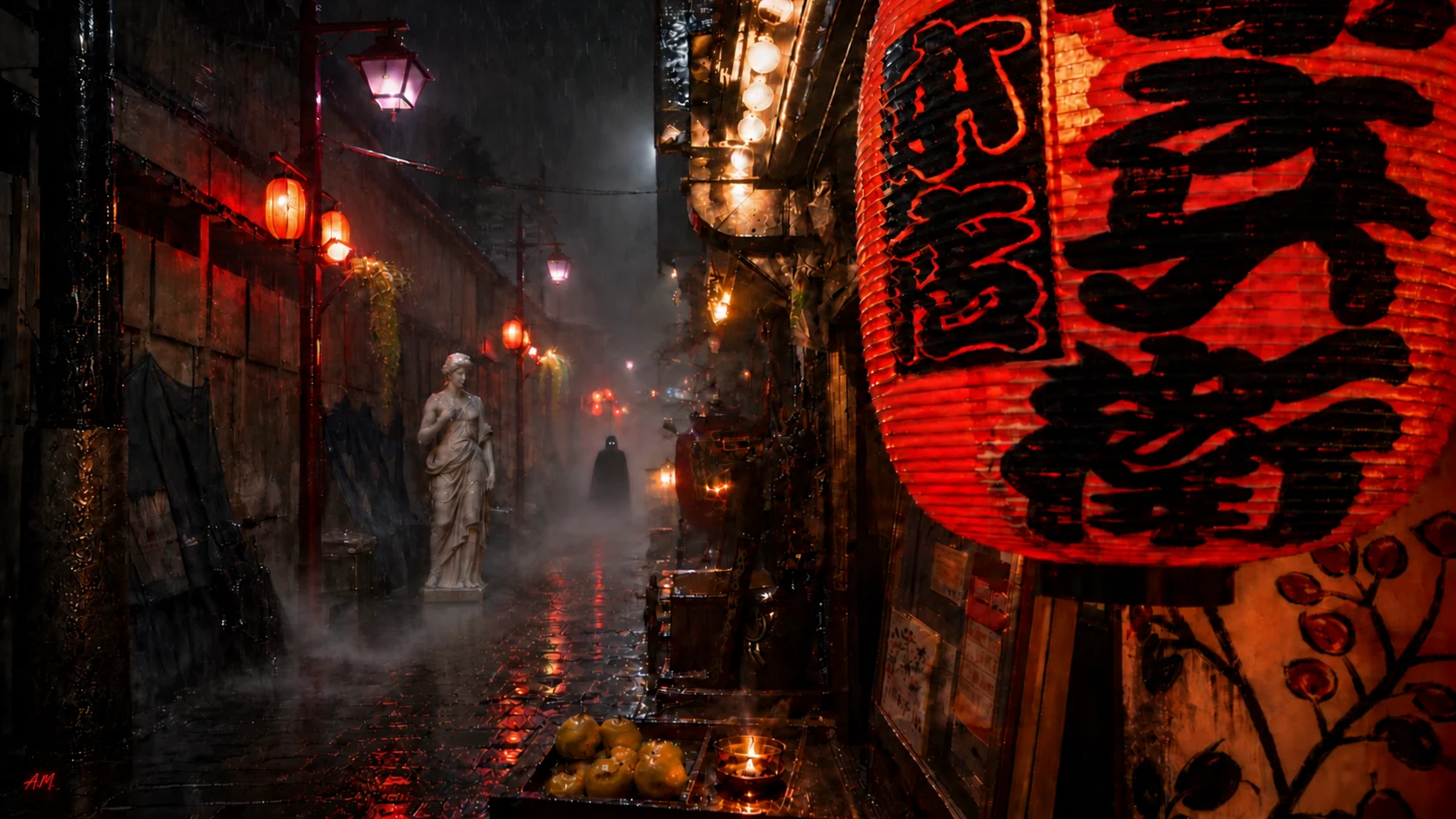
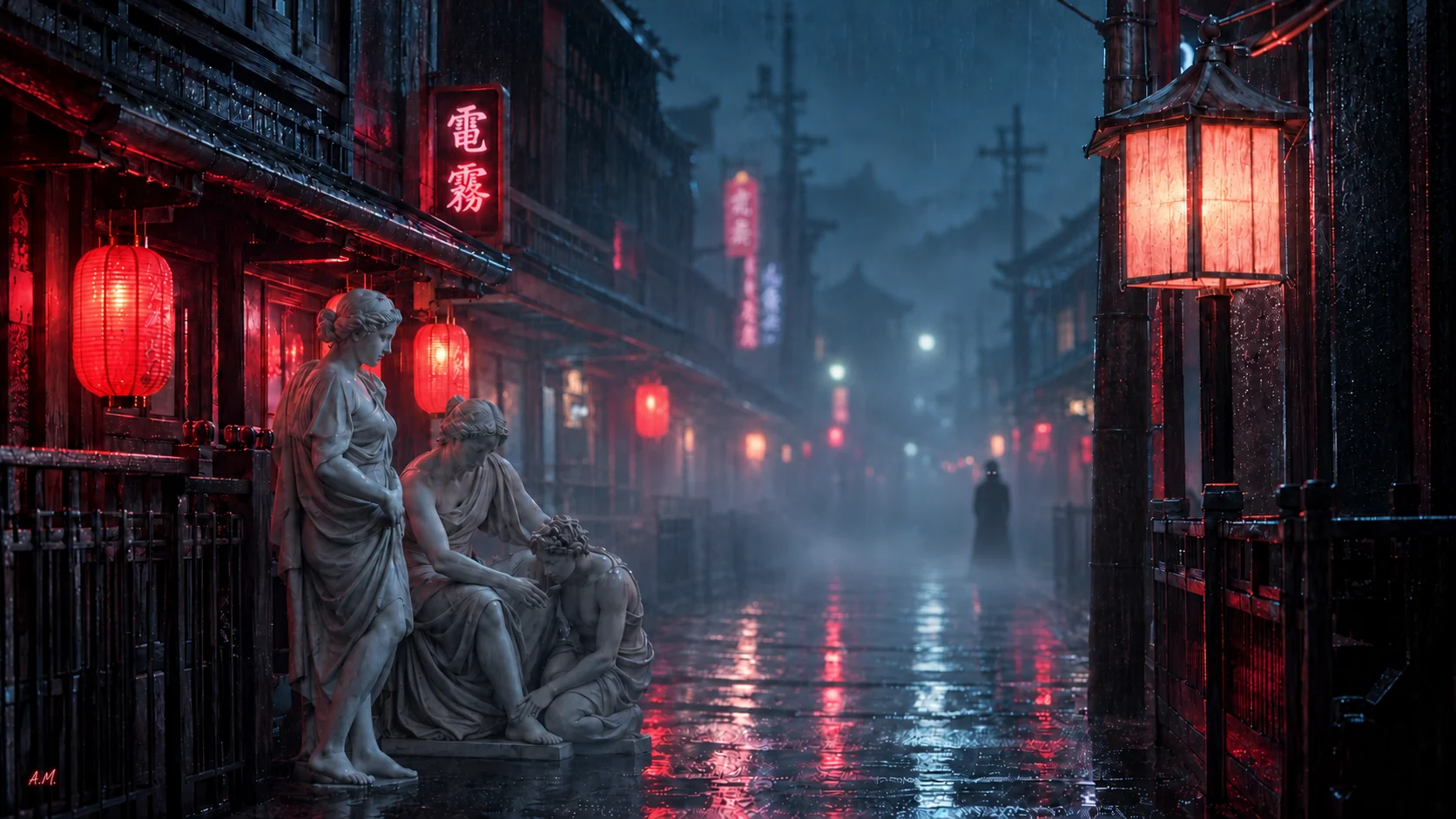
La bottega sembra aspettare un ultimo cliente. Sotto la lanterna, il vicolo conserva l’umidità dei passi e una statua presidia il silenzio. Qui si potrebbero ritrovare le notti dimenticate al risveglio, ancora intere, piegate dietro una porta. Nessuno espone il prezzo di ciò che abbiamo sognato una volta sola.The shop seems to be waiting for one last customer. Beneath the lantern, the alley holds the damp trace of footsteps, and a statue watches over the silence. Here one might find the nights forgotten on waking, still whole, folded behind a door. No price is displayed for what we have dreamed only once.
Il congedo che non finisceThe Farewell That Never Ends
EF–JP–03 Adriano Muzzi · 2026
Tre figure occupano il vicolo come le ultime parole di una conversazione. Nessuna sembra potersi allontanare per prima. La pioggia attraversa lo spazio che le divide, il rosso ne raggiunge i corpi immobili. Il saluto è già stato pronunciato; resta quel breve istante in cui partire somiglia ancora a restare.Three figures occupy the alley like the final words of a conversation. None seems able to leave first. Rain passes through the space between them; red light reaches their motionless bodies. The farewell has already been spoken. What remains is that brief instant when leaving still feels like staying.
Le custodi dell’ultimo autunnoThe Keepers of the Last Autumn
EF–JP–05 Adriano Muzzi · 2026
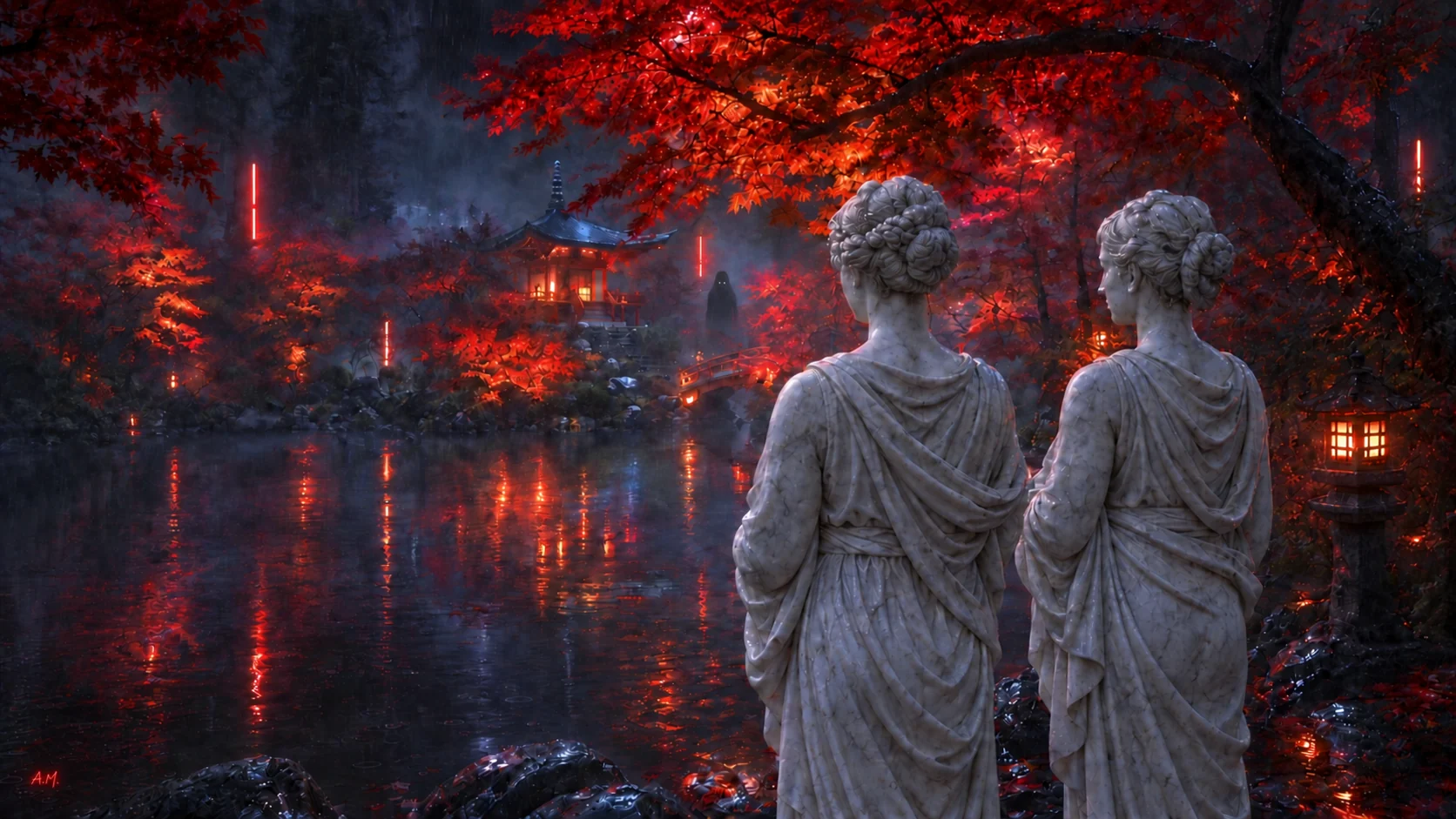
Le due figure guardano il lago da un tempo che l’acqua non restituisce. Davanti a loro, gli aceri trattengono il rosso e il tempio affiora oltre la nebbia. Nessuna si volta. Se una sola foglia dovesse cadere nel punto giusto, forse l’autunno potrebbe finalmente finire. Per questo sono rimaste.The two figures have been watching the lake for longer than the water can remember. Before them, the maples hold their red, and the temple emerges beyond the fog. Neither turns around. If a single leaf fell in the right place, perhaps autumn could finally end. That is why they have stayed.
L’assemblea di chi rimaneThe Assembly of Those Who Remain
EF–JP–09 Adriano Muzzi · 2026
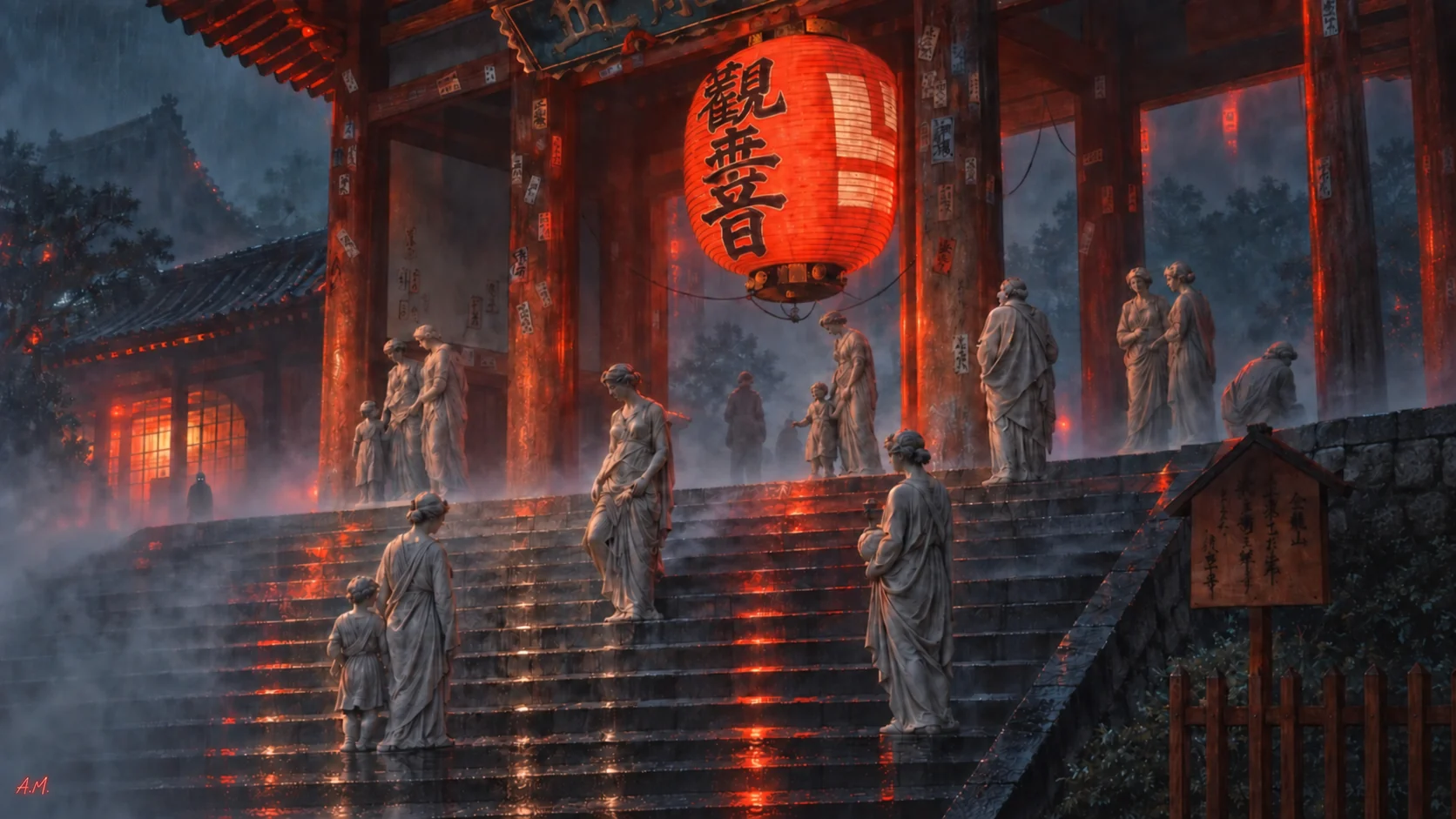
Sulla scalinata, ciascuna figura conserva il proprio posto. La riunione potrebbe cominciare da un momento all’altro, se qualcuno ricordasse chi l’ha convocata. Il rosso attraversa la nebbia e raggiunge il marmo. Sono rimasti tutti, anche dopo che l’ultima domanda è stata dimenticata. Ora il silenzio deve decidere per loro.On the stairway, each figure keeps its place. The gathering could begin at any moment, if someone remembered who had called it. Red light passes through the fog and reaches the marble. They have all remained, even after the last question was forgotten. Now silence must decide for them.
Il passaggio che dimentica la rivaThe Passage That Forgets the Shore
EF–JP–06 Adriano Muzzi · 2026
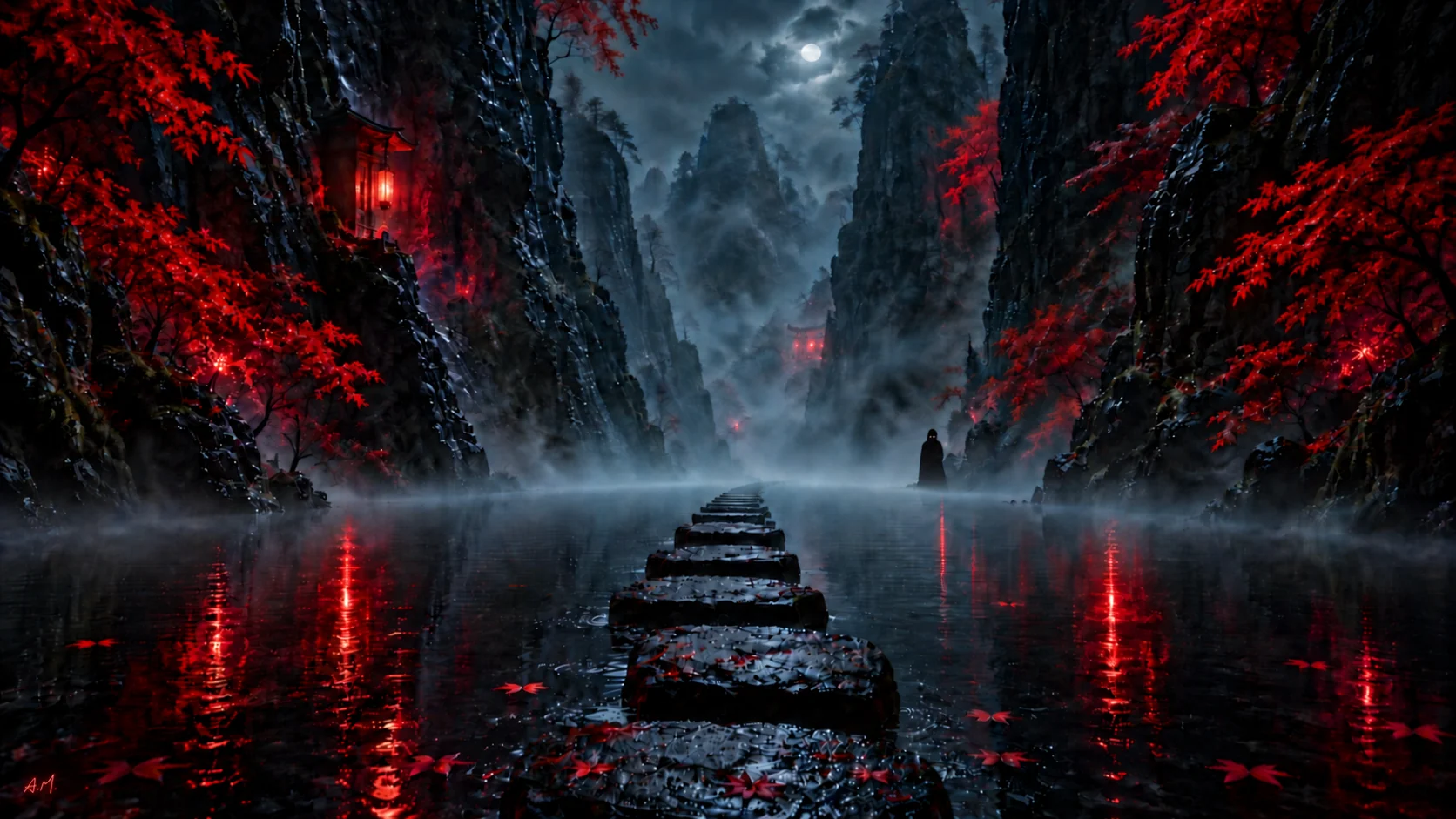
Una pietra dopo l’altra, il passaggio entra nell’acqua e perde la certezza di una riva. Le lanterne lasciano fili rossi sulla superficie; la luna illumina soltanto il tratto che possiamo vedere. Ai margini, due occhi bianchi restano aperti. Qualcuno conosce la destinazione, ma lascia che siamo noi a scegliere il prossimo passo.Stone by stone, the passage enters the water and loses the certainty of a shore. The lanterns leave red threads across the surface; the moon lights only the stretch we can see. At the edge, two white eyes remain open. Someone knows the destination, but lets us choose the next step.
L’impero sotto una luna estraneaThe Empire Beneath an Unfamiliar Moon
EF–JP–07 Adriano Muzzi · 2026
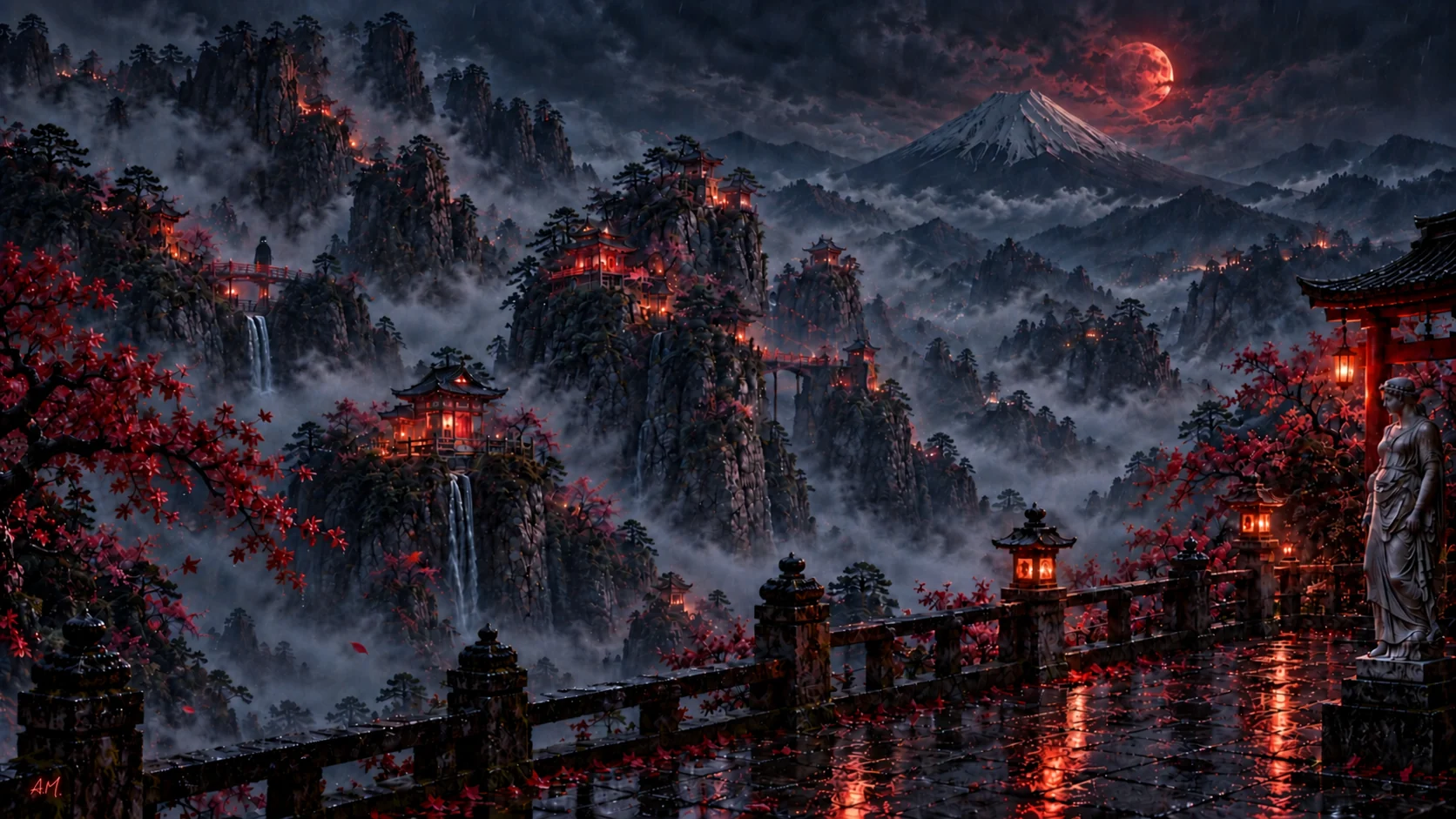
Dalla terrazza, i templi sembrano appartenere a un impero sopravvissuto al proprio nome. La luna rossa illumina le altezze con una luce che nessuno ricorda. Una figura di marmo continua a guardare. Forse attende un segnale dalle montagne; forse è l’ultima a sapere che il cielo, durante la notte, è stato sostituito.From the terrace, the temples seem to belong to an empire that has outlived its own name. The red moon lights the heights with a glow no one remembers. A marble figure keeps watch. Perhaps it awaits a signal from the mountains; perhaps it is the last to know that the sky was replaced during the night.
La distanza fra il regno e il sognoThe Distance Between Kingdom and Dream
EF–JP–10 Adriano Muzzi · 2026
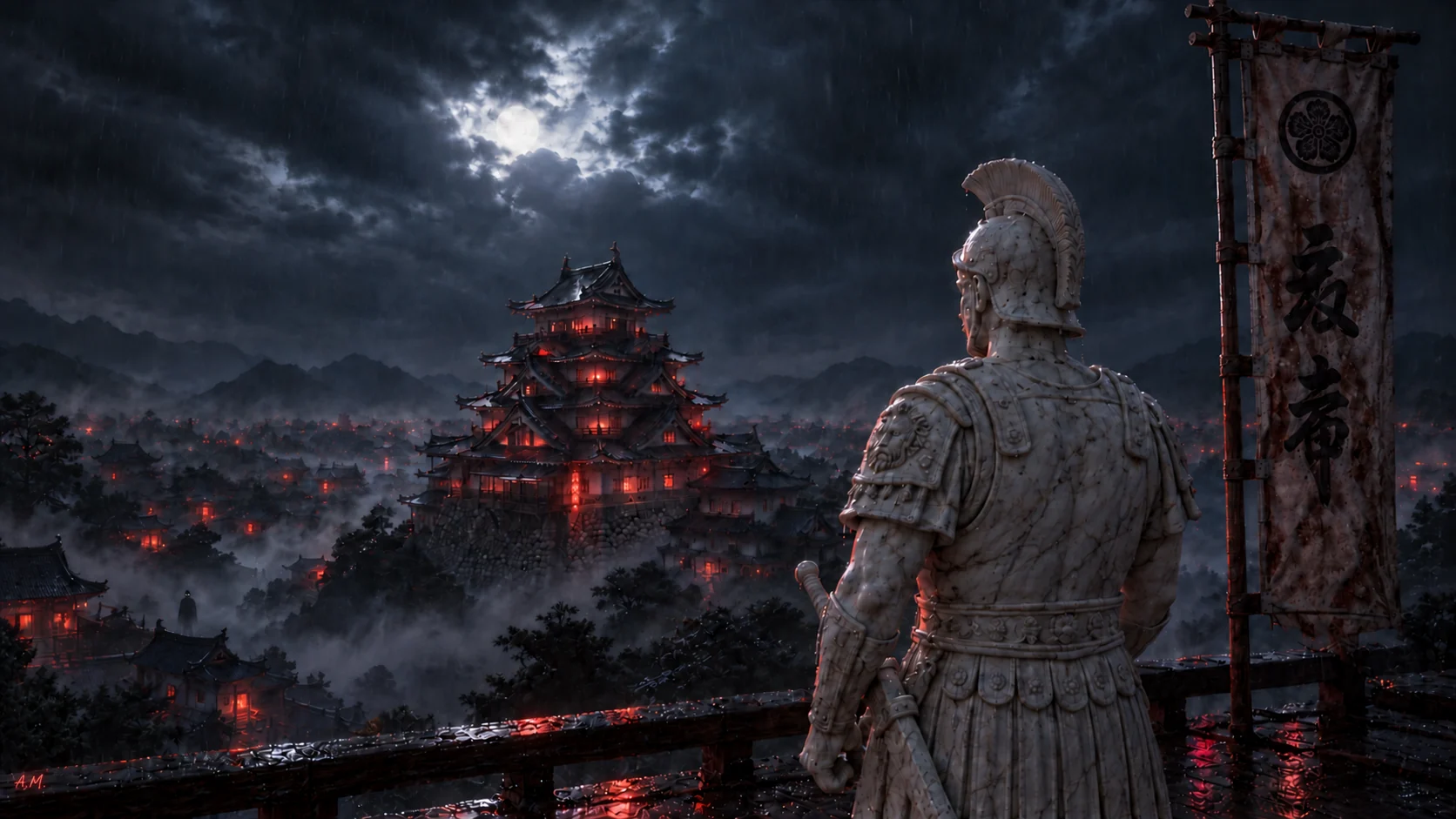
Il guardiano veglia davanti a un castello che la nebbia potrebbe riprendersi. Le luci rosse ne confermano la presenza, senza avvicinarlo. Ha attraversato epoche per arrivare fin qui, portando nel marmo il peso della consegna. All’alba dovrà ricordare se protegge il regno da chi sogna, o il sogno da chi si sveglia.The guardian keeps watch before a castle the fog might reclaim. Red lights confirm its presence without bringing it closer. It has crossed ages to reach this place, carrying the weight of its charge in marble. At dawn, it must remember whether it protects the kingdom from dreamers, or the dream from those who wake.
OLTRE LA DECIMA NOTTE · OTTO NUOVE OPEREBEYOND THE TENTH NIGHT · EIGHT NEW WORKS
La nebbia conosce altri luoghi.The mist knows other places.
La prima sequenza si chiude, ma il cammino continua. Otto nuovi luoghi aprono il prossimo capitolo del Giappone immaginato. Fra acqua, pietra e lanterne, ogni soglia conserva una domanda diversa.The first sequence ends, yet the journey continues. Eight new places open the next chapter of an imagined Japan. Among water, stone and lanterns, each threshold holds a different question.
11 / 18
Il sentiero che conta gli assentiThe Path That Counts the Absent
EF–JP–11 Adriano Muzzi · 2026
Entro fra i torii quando la pioggia ha già cancellato le orme. La donna di marmo è rimasta al primo varco; più avanti, due occhi bianchi attendono senza chiamare. Ogni porta rossa sembra uguale alla precedente, eppure il sentiero conosce il numero di chi è passato e di chi non è tornato. Mi fermo. Per un istante, la statua pare contare anche me.I enter among the torii after the rain has erased the footprints. The marble woman remains at the first threshold; farther on, two white eyes wait without calling. Every red gate resembles the last, yet the path knows who passed through and who never returned. I stop. For a moment, the statue seems to count me too.
La porta di chi non è tornatoThe Door of the One Who Never Returned
EF–JP–12 Adriano Muzzi · 2026
La porta è chiusa da così tanto tempo che la pioggia ha imparato a bussare al posto nostro. Sotto il tempio, il marmo trattiene un gesto a metà. Dall’alto, due occhi bianchi vegliano sulla soglia. Nessuno sa chi si trovi dall’altra parte; forse la porta custodisce soltanto il momento in cui qualcuno promise di tornare.The door has been closed so long that rain has learned to knock for us. Below the temple, marble holds a gesture halfway through. Above, two white eyes keep watch over the threshold. No one knows who is on the other side; perhaps the door preserves only the moment someone promised to return.
La luna entra dall’acquaThe Moon Enters Through the Water
EF–JP–13 Adriano Muzzi · 2026
Nella notte, i torii sorgono dall’acqua come porte lasciate aperte per chi non ha più una strada. La luna passa per prima; il rosso la segue sulla superficie increspata. Sulla riva, due occhi bianchi non si muovono. Aspetto che qualcuno attraversi, poi capisco che è l’acqua a farlo per noi.At night, the torii rise from the water like gates left open for those who have lost their way. The moon passes first; red follows it across the ripples. On the shore, two white eyes remain still. I wait for someone to cross, then understand that the water crosses for us.
Il vicolo che ascolta il marmoThe Alley That Listens to Marble
EF–JP–14 Adriano Muzzi · 2026
Le lanterne hanno acceso il vicolo, ma nessuno è uscito dalle case. Quattro figure di marmo occupano la strada come se avessero interrotto una conversazione. Più avanti, due occhi bianchi attendono fra la pioggia e il vapore. Forse il silenzio non è venuto dopo le loro parole. Forse è ciò che stavano dicendo.The lanterns have lit the alley, yet no one has come out of the houses. Four marble figures stand in the street as if a conversation had been interrupted. Farther on, two white eyes wait amid rain and steam. Perhaps silence did not follow their words. Perhaps it was what they were saying.
La mano che trattenne la pioggiaThe Hand That Held the Rain
EF–JP–15 Adriano Muzzi · 2026
Nel cortile la pioggia cade su ogni cosa, tranne sul gesto che il marmo sembra custodire. Una mano aperta, un’offerta senza oggetto. Dietro la nebbia, qualcuno osserva senza avvicinarsi. Rimango davanti alla statua finché non mi accorgo che attendo anch’io qualcosa che non ha ancora un nome.Rain falls on everything in the courtyard except the gesture the marble seems to keep. An open hand, an offering with nothing in it. Behind the mist, someone watches without drawing near. I remain before the statue until I realize I too am waiting for something that has no name yet.
La luce che pesa sul ritornoThe Light That Weighs on Returning
EF–JP–16 Adriano Muzzi · 2026
La grande lanterna veglia sui gradini e riempie la pioggia di rosso. Sotto di lei, una donna di marmo regge un ombrello che non può proteggerla. Ai margini, due occhi bianchi conoscono la strada verso il tempio. Mi domando se sia più difficile salire quei gradini o ricordare perché si era partiti.The great lantern watches over the steps and fills the rain with red. Beneath it, a marble woman holds an umbrella that cannot shelter her. At the edge, two white eyes know the way to the temple. I wonder what is harder: climbing those steps or remembering why one left.
La tazza per chi non arrivaThe Cup for the One Who Never Comes
EF–JP–17 Adriano Muzzi · 2026
La stanza è pronta. La donna porge una tazza verso il posto rimasto vuoto, mentre fuori la pioggia attraversa gli alberi rossi. Al di là della soglia, due occhi bianchi brillano nella nebbia. Il tè si raffredderà, ma quel gesto resterà sospeso: certe attese non chiedono a nessuno di arrivare.The room is ready. The woman offers a cup toward the empty place while rain moves through the red trees outside. Beyond the threshold, two white eyes shine in the mist. The tea will cool, but the gesture will remain suspended: some forms of waiting ask no one to arrive.
Il saluto rivolto alla nebbiaThe Farewell Addressed to the Mist
EF–JP–18 Adriano Muzzi · 2026
Nella risaia allagata, una donna di marmo solleva la mano verso la strada. Il sentiero conduce ai torii sulla collina; una piccola presenza scura lo percorre lentamente. Non so se sia un saluto o un richiamo. La pioggia cancella la distanza fra i due, ma lascia intatto il gesto.In the flooded rice field, a marble woman raises her hand toward the path. It leads to the torii on the hill; a small dark presence follows it slowly. I cannot tell whether this is a farewell or a summons. Rain erases the distance between them, but leaves the gesture untouched.
Tra una riva e l’altra, la nebbia custodisce passaggi che si aprono per un istante. Dieci opere seguono la luce fin dove tocca l’acqua, la neve e il marmo.Between one shore and the next, mist keeps passages that open for an instant. Ten works follow the light to where it touches water, snow and marble.
La stanza della nebbiaThe Room of Mist
Il tè doveva essere per qualcuno. La stanza è pronta da così tanto tempo che anche la notte, sulla veranda, ha imparato ad aspettare.The tea must have been meant for someone. The room has been ready for so long that even the night, out on the veranda, has learned to wait.
Quando la marea arrivò ai garretti, il cervo era ancora di pietra. Fu il riflesso a fare il primo passo.When the tide reached its hocks, the deer was still stone. Its reflection took the first step.
La pioggia conosce ogni asse del ponte. Su una soltanto, quando il monaco passa, le gocce sembrano cadere verso l’alto.The rain knows every plank of the bridge. On just one, as the monk passes, the drops seem to fall upwards.
L’acero si piega da entrambi i lati della porta. Le foglie che cadono oltre il cerchio appartengono a un altro autunno.The maple bends on both sides of the gate. The leaves that fall beyond the circle belong to a different autumn.
Una tazza è rimasta sul bordo della gola. Quando il vapore si alza, il padiglione dall’altra parte scompare per il tempo di un sorso.A cup has been left at the edge of the ravine. When its steam rises, the pavilion across the gorge disappears for the length of one sip.
A quell’ora, in fondo al vicolo, rimane accesa una sola lanterna. Chi ci passa sotto sente pronunciare il proprio nome dalla casa vuota.At that hour, a single lantern is left burning at the end of the alley. Those who pass beneath it hear their name spoken from the empty house.
Il dito era già rivolto al cielo quando la riva era ancora buia. Al sorgere della Luna, qualcuno capì che il gesto indicava anche un’ora.The finger was already pointing skywards while the shore was still dark. When the moon rose, someone realised the gesture had marked an hour as well.
La neve ha cancellato le orme. Sui gradini più alti, qualcuno conosce ancora la strada.The snow has erased the footprints. On the highest steps, someone still knows the way.
Il rematore dell’ultima luceThe Rower of the Last Light
A ogni colpo di remo, il tramonto si spezza. Dietro la barca, l’acqua lo ricompone.With each stroke of the oar, the sunset breaks apart. Behind the boat, the water pieces it together again.
La soglia dei due fuochiThe Threshold of Two Fires
Il rosso sale dalla terra, il blu scende dalla Luna. Sul gradino dove si incontrano, qualcuno aspetta.Red rises from the earth, blue descends from the moon. On the step where they meet, someone waits.
Una tazza tenuta fra le mani, un ombrello lasciato sui gradini, una campana che deve ancora suonare. La notte trattiene questi gesti il tempo di un respiro.A cup held in two hands, an umbrella left on the steps, a bell that has yet to ring. The night holds these gestures for the length of a breath.
Le nozze della pioggiaThe Wedding in the Rain
Al terzo gradino, la pioggia aveva già imparato i loro nomi. Dalla porta, qualcuno attendeva ancora il sì.By the third step, the rain had already learned their names. In the doorway, someone was still waiting for them to say yes.
Due tazze furono sollevate. La terza rimase accanto al focolare, dalla parte di chi doveva ancora entrare.Two cups were lifted. The third stayed beside the hearth, on the side of whoever had yet to enter.
Il ponte delle foglie fermeThe Bridge of Still Leaves
Una si voltò verso la lanterna. L’altra continuò a camminare. Sul ponte, una foglia restò ferma sotto la pioggia.One turned towards the lantern. The other kept walking. On the bridge, a leaf lay still in the rain.
Le tazze sono sospese da così tanto tempo che il vapore si è disperso nel giardino. Le labbra custodiscono ancora il primo sorso.The cups have been held aloft so long that the steam has drifted into the garden. Their lips still hold the first sip.
A ogni gradino, il bambù restituisce la voce della pioggia. Dopo l’ultima lanterna, si sente un solo passo.At every step, the bamboo gives back the voice of the rain. Beyond the last lantern, a single footfall can be heard.
Le lanterne furono affidate all’acqua una alla volta. Soltanto l’ultima, quando vide la figura sul ponte, risalì la corrente.The lanterns were set adrift one by one. Only the last, when it saw the figure on the bridge, turned back against the current.
L’ombrello di chi è già passatoThe Umbrella of Someone Gone By
La pietra sotto la carta è ancora asciutta. Più in alto, qualcuno si allontana portando con sé il rumore dei propri passi.The stone beneath the paper is still dry. Further up, someone walks away, taking the sound of their footsteps with them.
La campana prima del suonoThe Bell Before It Rings
Il battente è a un soffio dal bronzo. Sotto la gronda, chi ha posato la scopa aspetta di sapere quale ora verrà chiamata.The striker is a breath away from the bronze. Beneath the eaves, whoever set down the broom waits to hear which hour will be called.
Il fiore ha già lasciato il ramo. Nel marmo, lo sguardo conserva il momento in cui era ancora lassù.The blossom has already left the branch. In marble, her gaze holds the moment when it was still up there.
La nebbia attraversa il cortile. Il marmo accenna un gesto. Per un istante, ciò che aspettava comincia ad accadere.Mist crosses the courtyard. Marble begins a gesture. For an instant, what was waiting starts to unfold.
La mano che trattenne la pioggiaThe Hand That Held the Rain
La pioggia le aveva attraversato i secoli. Quella notte, la mano di marmo si mosse.Rain had washed over her through the centuries. That night, the marble hand moved.
Allungò un dito verso il vuoto. Dove avrebbe dovuto esserci soltanto acqua, una luce cominciò a ricordare il suo volto. Le nacquero di fronte le stesse pieghe, lo stesso silenzio, una mano capace di raggiungerla.She reached a finger towards the empty air. Where there should have been only water, a light began to remember her face. Before her, the same folds took shape, the same silence, a hand that could reach her.
Quando le dita si sfiorarono, dalla soglia qualcuno vide due solitudini riconoscersi. La pioggia continuò a cadere. Fra quelle mani, per un istante, non arrivò.When their fingertips touched, someone at the doorway saw two solitudes recognize each other. The rain kept falling. Between those hands, for an instant, it did not fall.
L’attesa ha una dimoraWaiting Has a Home
Una testa si volta. La distanza fra due presenze cambia, senza che nessuno faccia un passo.A head turns. The distance between two presences changes, though neither takes a step.
L’attesa ha una dimora — IIWaiting Has a Home — II
Il marmo indica una presenza nella nebbia. Qualcuno muove pochi passi, e l’attesa cambia forma.Marble points toward a presence in the mist. Someone takes a few steps, and waiting changes its shape.
La veglia delle cose immobiliThe Vigil of Still Things
La luce esita nel bronzo. Dalla soglia emerge una presenza, mentre il marmo custodisce la notte.Light falters inside the bronze. A presence emerges from the threshold, while marble keeps watch over the night.
La bottega delle notti perduteThe Shop of Lost Nights
Ci sono luoghi che aprono soltanto quando la città dorme.There are places that open only when the city sleeps.
La pioggia cade, le lanterne respirano nella nebbia e le luci tremano come ricordi che non vogliono spegnersi. Una statua veglia immobile sul vicolo. Più lontano, una piccola figura nera attraversa lentamente la foschia.Rain falls, lanterns breathe through the fog, and lights flicker like memories refusing to fade. A marble figure keeps its silent watch over the alley. Farther away, a small dark figure moves slowly through the mist.
Non sappiamo da dove venga. Non sappiamo cosa stia cercando.We do not know where he comes from. We do not know what he is looking for.
Poi si avvicina alla bottega e scompare.Then he reaches the shop and disappears.
Forse alcune notti non finiscono. Aspettano semplicemente qualcuno che torni a cercarle.Perhaps some nights never end. They simply wait for someone to come looking for them again.
Le campane dell’ora assenteThe Bells of the Absent Hour
Le campane hanno suonato. Nessuna mano le aveva toccate.The bells rang. No hand had touched them.
Dal bronzo affiora una luce rossa. Gira nella nebbia, sfiora i pini, attraversa le pietre bagnate. Ogni cosa emerge dal buio per un istante, come un ricordo che cerca chi lo ha vissuto.A red light rises from the bronze. It turns through the mist, brushes the pines and crosses the wet stones. Everything emerges from darkness for an instant, like a memory searching for the person who lived it.
Tra un rintocco e l’altro c’è spazio per una vita intera. Sotto il portico, due occhi bianchi aspettano. Forse quest’ora non appartiene a chi è venuto ad ascoltare.Between one toll and the next, there is room for an entire lifetime. Beneath the portico, two white eyes wait. Perhaps this hour does not belong to those who have come to listen.
Il congedo che non finisceThe Farewell That Never Ends
Mi sono fermato sotto la gronda. Tre figure di marmo custodivano un saluto che la notte non riusciva a sciogliere.I stopped beneath the eaves. Three marble figures held a farewell that the night could not release.
Poi la pietra ha ceduto a un gesto. Una mano ha cercato l’altra, e per un istante ho dimenticato chi dovesse partire. La pioggia continuava a cadere; il rosso delle lanterne tremava ai loro piedi.Then stone yielded to a gesture. One hand reached for another, and for an instant I forgot who was meant to leave. Rain kept falling; the red of the lanterns trembled at their feet.
In fondo al vicolo, due occhi bianchi aspettavano nella nebbia. Non ho chiesto da quanto tempo fossero lì. Temevo che stessero aspettando me.At the end of the alley, two white eyes waited in the mist. I did not ask how long they had been there. I feared they were waiting for me.
Le custodi dell’ultimo autunnoThe Keepers of the Last Autumn
Le custodi non si voltano. Eppure qualcosa turba il lago: cerchi rossi si allargano sull’acqua, come un ricordo che cerca la superficie. Nessuno ha sfiorato lo specchio. La notte, forse, ricorda ancora.The keepers do not turn. Yet something disturbs the lake: red rings widen across the water, like a memory searching for the surface. No one has touched the mirror. Perhaps the night still remembers.
L’assemblea di chi rimaneThe Assembly of Those Who Remain
Salgo i gradini senza sapere quale soglia mi attenda. Le statue si raccolgono sotto la lanterna, ciascuna assorta nel proprio silenzio; in fondo, due occhi bianchi custodiscono la nebbia.I climb the steps without knowing which threshold awaits. The statues gather beneath the lantern, each absorbed in its own silence; far away, two white eyes keep watch within the mist.
La pioggia cancella le impronte appena nate. Eppure nessuno se ne va: forse l’assemblea è cominciata molto prima del mio arrivo.Rain erases each new footprint. Yet no one leaves: perhaps the assembly began long before I arrived.
Il peso di una luce — IThe Weight of a Light — I
Una mano di marmo si avvicina alla sfera. L’acqua custodisce i cerchi di un’attesa.A marble hand approaches the sphere. Water holds the circles of a waiting moment.
Il peso di una luce — IIThe Weight of a Light — II
La luce disegna sulla sfera ciò che la pietra non sa pronunciare.Light traces across the sphere what stone cannot utter.
Il passaggio che dimentica la rivaThe Passage That Forgets the Shore
Poso il piede sulla prima pietra. La riva alle mie spalle svanisce; quella davanti non ha ancora un nome. Nel silenzio del lago, il monaco comprende: attraversare non significa arrivare, ma lasciare che la nebbia custodisca ciò che siamo stati.I place my foot on the first stone. The shore behind me fades; the one ahead has no name yet. In the lake’s silence, the monk understands: to cross is not to arrive, but to let the mist keep what we once were.
L’impero sotto una luna estraneaThe Empire Beneath an Unfamiliar Moon
Da questo crinale, il monaco osserva la luna rossa sopra il monte. La nebbia si muove fra pagode e foreste; i riflessi tremano sulla pietra bagnata. La statua rimane alla soglia, mentre il paesaggio sembra respirare. In un impero sospeso fra veglia e sogno, ogni luce indica una strada e ne nasconde un’altra.From this ridge, the monk watches the red moon above the mountain. Mist moves among pagodas and forests; reflections tremble on the wet stone. The statue remains at the threshold while the landscape seems to breathe. In an empire suspended between waking and dream, every light points to a path and conceals another.
La distanza fra il regno e il sognoThe Distance Between Kingdom and Dream
Dal margine della terrazza, il guardiano di marmo si volta. Sotto di lui, le luci del castello resistono alla pioggia; una piccola presenza rimane fra i tetti e la nebbia. Il monaco osserva in silenzio. Non sa se il guardiano custodisca un regno reale o l’ultimo istante di un sogno. Fra i due c’è una distanza che nessuno osa attraversare.At the edge of the terrace, the marble guardian turns. Below him, the castle lights endure the rain; a small presence remains among the rooftops and the mist. The monk watches in silence. He cannot tell whether the guardian protects a real kingdom or the final moment of a dream. Between the two lies a distance neither dares to cross.
Ogni film si avvia con Play e conserva il proprio suono. Se stai ascoltando Mesa, metti in pausa Spotify prima di avviare un video.Press Play to start each film with its own sound. If Mesa is playing, pause Spotify before starting a video.
L’AUTORETHE ARTIST
Adriano Muzzi
Adriano Muzzi vive a Roma e cerca nelle immagini quell’istante in cui un luogo smette di esserci familiare. Una luce rimasta accesa, il marmo sotto la pioggia, una figura che aspetta ai margini: da queste presenze nasce Electric Fog. Le sue immagini diventano luoghi in cui il tempo esita e qualcosa di noi continua ad abitare, anche dopo la partenza. La scrittura ne attraversa le soglie: i titoli sono parole lasciate sulla porta, perché chi guarda possa entrare con i propri ricordi.Adriano Muzzi lives in Rome and searches his images for the instant when a place ceases to feel familiar. A light left burning, marble in the rain, a figure waiting at the edge: Electric Fog begins with these presences. His images become places where time hesitates and something of us remains, even after we have gone. Writing crosses their thresholds: the titles are words left at the door, inviting viewers to enter with their own memories.
Fotografie originali rielaborate digitalmente con strumenti di intelligenza artificiale e direzione artistica dell’autore.Original photographs digitally reworked using artificial intelligence tools and the artist’s own artistic direction.